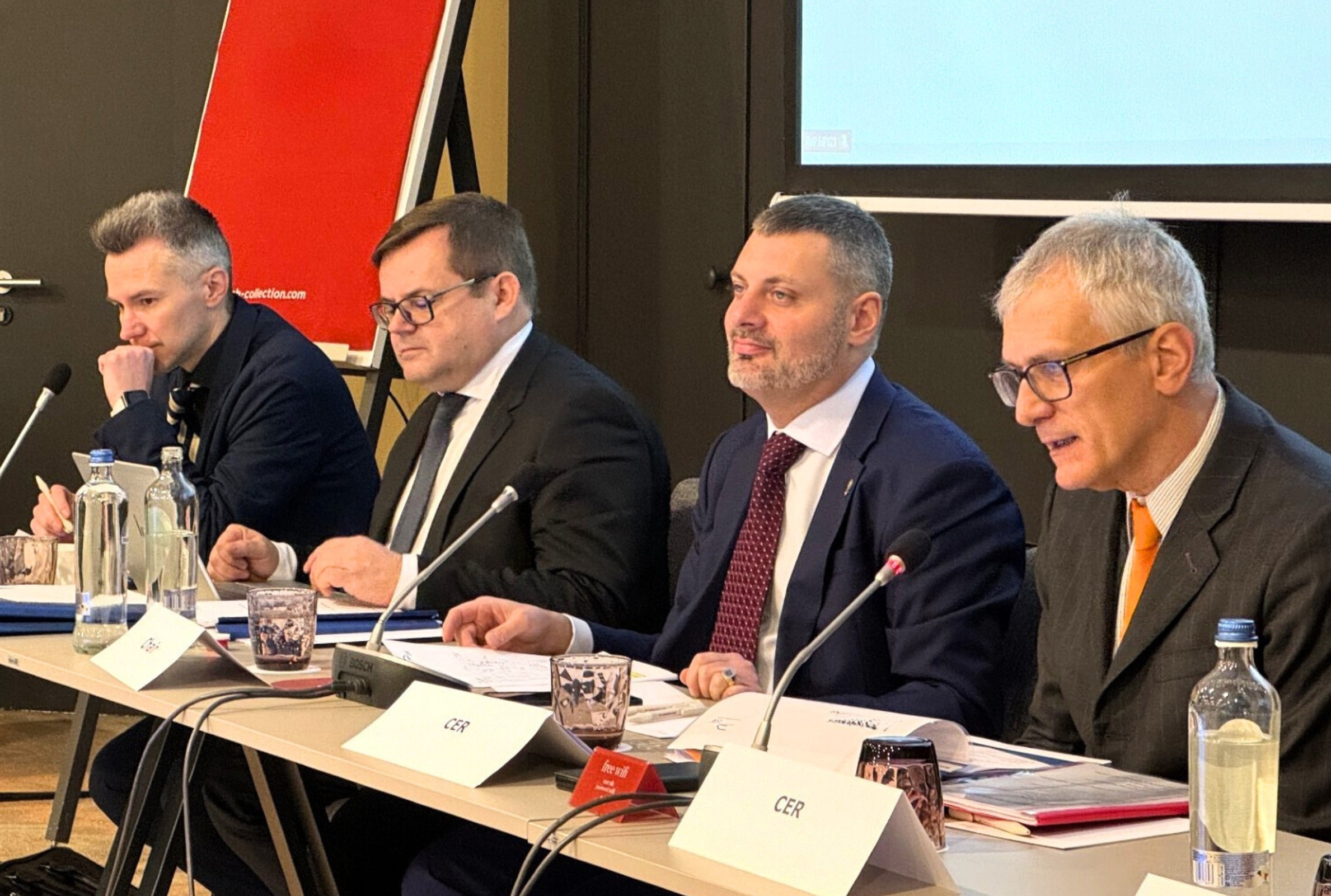
European rail CEOs set strategic direction for 2026 at CER General Assembly
Rail CEOs from across Europe gathered in Brussels for the General Assembly of the Community of European Railway and Infrastructure Companies (CER), where they agreed on the association’s strategic priorities for 2026, appointed new members to the Management Committee, welcomed two new organisations as members, and adopted positions on two key EU policy files.
CER priorities for 2026
Members endorsed a focused agenda that will guide CER’s advocacy in the year ahead. The priorities reflect the sector’s ambition to strengthen Europe’s competitiveness, resilience and connectivity. They include securing strong EU funding for rail in the next Multiannual Financial Framework; reinforcing Europe’s Military Mobility framework; supporting implementation of the European High‑Speed Rail Plan, with attention to financing, permitting, industrial capacity and cross‑border coordination; advancing digital rail technologies such as ERTMS with a focus on cost efficiency and deployment realism; and addressing structural challenges in rail freight to safeguard intermodal competitiveness and prevent reverse modal shift.
CER will also continue its work on ticketing and passenger rights, climate and energy policy, cost reduction, and implementation of the new Regulation on railway infrastructure capacity.
New leadership appointments
The General Assembly appointed four new members to the CER Management Committee: Jean Castex, Chairman and CEO of SNCF Group; Henrik Dahlin, CEO of Green Cargo AB and Deputy Chairman of ASTOC, who will serve as a consultative member, Miroslav Garaj, Director General of ŽSR; and Tomáš Tóth, Director General of Správa železnic, who joins as Vice‑Chair. Their combined experience strengthens CER’s leadership at a pivotal time for European rail.
Two new members join CER
CER also welcomed two new organisations into its membership. Línea Figueras Perpignan S.A. (LFP), which manages the 44.4 km Perpignan–Figueres cross‑border high‑speed line including the El Pertús tunnel, brings valuable expertise in international infrastructure management. Network Rail, the national infrastructure manager of Great Britain’s railway network, also joins the association, further broadening CER’s representation across Europe’s rail system.
CER adopts positions on Military Mobility and Vehicle Authorisation
In line with their newly endorsed priorities, members approved two new policy papers addressing important EU legislative developments. On Military Mobility, CER welcomes the 2025 Military Package as a significant step toward a “Military Schengen” and sets out recommendations to ensure the proposed Regulation is workable for rail. These include the need to clarify compensation mechanisms under the emergency framework, refine the design of the Solidarity Pool, and carefully assess the expanded powers foreseen for the European Union Agency for Railways (ERA).
On Vehicle Authorisation, CER proposes improvements to make the ERA authorisation process faster, more efficient and less costly for applicants. The paper outlines measures to ensure approvals do not exceed five months, a crucial requirement for both new rolling stock and major retrofits such as FRMCS and Digital Automatic Coupling (DAC). Streamlining this process will help increase rolling stock availability and reduce time to market.
CER Executive Director Alberto Mazzola said: “Europe’s railways are united behind a clear agenda for 2026. Strong funding, digital transformation, military mobility and high speed rail are all essential to building a more resilient, competitive and sustainable Europe. Today’s decisions show a sector ready to work together, with partners and with EU institutions to deliver the rail system Europe needs.”
Download below the press release.